
Japanese Tattooing in South Florida — What It Actually Takes
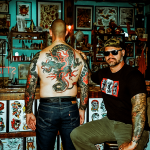
I’ve been tattooing since shortly after high school. Started my apprenticeship at Tatts Taylor’s in Fort Lauderdale a legendary shop. Japanese-style work grabbed me early, and it’s never let go. Three decades in, it’s still what I care about most. Not because it’s trendy it was never really trendy. It just happens to be the most complete, demanding, and satisfying form of tattooing that exists.
People walk in here all the time and say they want “a Japanese tattoo.” Usually they’ve got a reference photo on their phone sometimes a koi from Instagram, sometimes a dragon sleeve they spotted at the gym. And I always ask the same thing: do you want a Japanese-inspired image, or do you want to actually do this right? Because those are two very different conversations.
This article is for the people who want to do it right.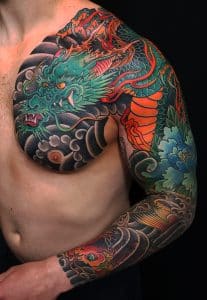
What Irezumi Actually Is
Irezumi the traditional Japanese approach to tattooing isn’t just an aesthetic. It’s a system. A way of thinking about how imagery lives on the body that was developed and refined over centuries. The word itself comes from two Japanese characters: ire, to insert, and sumi, ink. But what’s really being inserted is something bigger than pigment.
Traditional Japanese tattooing treats the body as a landscape. Not a collection of separate surfaces where you place individual pictures, but a continuous terrain where everything connects. A sleeve doesn’t simply fill the arm with Japanese images it flows. The background the wind bars, the waves, the clouds, the maple leaves, the cherry blossoms creates a world. The main subject lives in that world. Every panel on every part of the body is in conversation with every other panel.
That’s what separates Irezumi from someone just tattooing Japanese-style images: the structure, the thinking behind how pieces relate to each other, the negative space. The way a dragon reaching down one arm responds to a phoenix climbing the other. The way koi swimming up a leg work with or against the natural muscle flow of the thigh.
Understanding this is the starting point for everything.
The Subject Matter What These Images Mean and Why It Matters
I’ve tattooed most of the major figures from the Japanese tradition at least a hundred times each koi, dragons, oni and Hanya, tigers, cranes, samurai, Fudo Myoo, phoenix, namakubi. Each one carries specific meaning that was established long before any of us picked up a machine. Knowing what these images mean gives you better tattoos. Always.
Koi and Dragons
Koi are probably the most requested Japanese subject I do. Most people know the basic idea determination, perseverance, the story of the fish swimming upstream and transforming into a dragon. What they don’t always consider, however, is how that story should inform placement and composition. Koi traditionally swim upstream, so when I’m designing a koi piece, I’m thinking about which direction it moves on the body and how the current it’s fighting against reads on the skin when the person is standing or moving. A koi that’s just floating there isn’t really doing its job. It’s got somewhere to be.
Dragons in Japanese tradition are nothing like the Western version not villains, but forces of nature: water, weather, wisdom, power. As protectors, they’re depicted in motion almost always, because a Japanese dragon isn’t a monster that sits in a cave. It moves through clouds, through water, through smoke. As a result, when I’m building a dragon sleeve or back piece, the dragon needs to feel like it’s actually traveling somewhere. Scale arrangement, the curve of the body, how the claws read, the direction the head faces all of this matters.
Oni, Tigers, and Cranes
Oni are Japanese demons big, powerful, often depicted in red or blue with wild hair and club weapons. In Japanese tradition, however, oni aren’t purely evil. They’re complex enforcers of divine justice who punish the wicked. The Hanya mask the jealous female demon is another subject I do constantly. Her expression holds love and rage simultaneously. That’s the whole point. The face tells an entire story by itself.
Tigers in Japanese tattooing are bamboo-and-mountain creatures representing the earth, courage, and the ability to ward off evil. Paired with a dragon which represents heaven and water you’ve got one of the great balancing acts in the entire tradition. When the composition is right, it simply works.
Cranes represent longevity, good fortune, and loyalty. They’re also beautiful to execute on the body because of the wingspan they naturally want to spread across large surfaces. A crane over a thigh or a back panel with an implied pond beneath it is one of my favorite things to make. There’s a stillness to that image that almost nothing else in the Japanese catalog has.
Why Japanese Tattooing Works in South Florida
I’m a Florida native. Born here, built my career here, raised my family here. I’ve been tattooing South Florida skin my whole professional life, and I’ve thought about this question a lot.
South Florida isn’t kind to tattoos. The sun is relentless, the salt air dries everything out, and people are in the water constantly. If you’re going to live in this climate and stay tattooed, you need work that can survive it.
Fortunately, Japanese tattooing done correctly holds up in this environment better than almost anything else. The reason is the same reason it’s held up for centuries: bold, saturated color work over strong black foundations ages with more grace than delicate fine-line work or hyper-realistic shading. The black in a well-executed Japanese background doesn’t vanish in the Florida sun. The peonies in a sleeve don’t blur into nothing. The koi keeps its definition. You still have to care for it SPF, moisturizer, staying out of direct sun during the heal — but the work itself is built to last.
Beyond durability, there’s something else that fits. South Florida is loud, colorful, unapologetic and the people who live here tend to be the same way. A full Japanese bodysuit doesn’t feel out of place in Miami or Delray Beach the way it might somewhere else. The culture here has always embraced big art and confident expression. That’s part of why I’ve never left.
The Commitment — What You’re Actually Signing Up For
Large-scale Japanese tattooing is not a one-sitting project. It is not something you decide on a Tuesday and finish by the weekend. I’ve had clients I’ve worked with for five, ten, fifteen years. What started as a three-quarter sleeve kept growing because the client trusted the process and wanted to keep going. That happens a lot with Japanese work. Once you start, and once it’s done right, it pulls you forward.
To give you a realistic picture: a sleeve arm from shoulder to wrist is generally three to six sessions depending on complexity, detail level, and your ability to sit. A half sleeve is two to four. A back piece can be ten to twenty sessions or more spread over a couple of years. A full bodysuit is a years-long relationship with one artist.
None of this is a complaint it’s simply reality. The clients who understand this upfront end up with the best tattoos because they’re not rushing. They’ve committed to the journey.
What I always tell people is: think of a Japanese piece like a tailored suit. It’s made to fit you specifically the proportions, the flow, the way it wraps around your specific body. Generic designs pulled from the internet can be a starting point for a conversation, but ultimately what ends up on your skin should be built for you. That takes time and it takes collaboration.
What a Good Consultation Looks Like
Before I start any significant Japanese piece, I want a real conversation not just a reference photo. I want to know what drew you to Japanese tattooing specifically, what images resonate, and what you want to feel when you look at your arm in twenty years.
Practical questions matter just as much. What do you do for work? Do you need to cover it sometimes? Do you spend a lot of time in the water? What’s your pain threshold honestly? Are you in this for the long game or are you hoping to get most of it done in two sessions?
Your answers directly change how I approach the design. For example, someone who’s outdoors constantly in Florida needs to understand that certain placement and color choices are going to age differently than the same piece on someone who works in an office. Similarly, someone who wants to stop at a sleeve needs a very different starting point than someone who’s eventually thinking about a torso.
In addition to that conversation, I’m also looking at the body before putting a single line on anyone thinking about how the design moves with the muscle groups, where the natural landmarks are, how a composition will read when you’re standing still versus in motion. No amount of online reference images can substitute for this. It requires being in the room, looking at the actual person.
What Separates Good Japanese Tattooing from Bad
I say this not to be arrogant, but because I’ve watched people bring me work that someone else did and the fix is harder than starting fresh would have been. There is a real skill gap in this style, and it’s bigger than people realize from the outside.
Black Work and Background
First, look at the black. In traditional Japanese tattooing, the black has to be dense and consistent. Thin, patchy black that hasn’t been packed in properly falls apart fast by year three, you’ll see daylight through the work. Always look at healed photos, not fresh ones. Fresh tattoos look better than they will at two years.
Second, examine the background. The waves, the clouds, the smoke, the wind this is where a lot of artists get lazy or sloppy. The background, however, is half the piece. Bad background work makes the whole composition feel unfinished and disconnected. Good background work, by contrast, is invisible in the sense that you stop noticing it as a separate thing. It simply becomes the world the subject lives in.
Flow and Artist Consistency
Third, consider the flow. Japanese tattooing should look like it belongs on the body it’s on. Designs that were drawn flat on paper and transferred without thinking about the three-dimensional surface they’re going on almost always feel wrong. A design that flows correctly, however, moves with the body. It breathes.
Fourth and this is the one people don’t think about enough look at the consistency of the artist’s body of work. A portfolio with one or two good Japanese pieces among a dozen other styles doesn’t tell you much. Instead, you want someone who does this constantly, who knows what a Fudo Myoo looks like not because they Googled it but because they’ve drawn it twenty times. That knowledge comes through in the work. It’s a different depth of commitment than you’ll find in someone who splits their time equally between Japanese, American Traditional, and realism.
Where Japanese Tattooing Fits at Vatican
Japanese work has always been the backbone of what I personally do at Vatican Tattoo Studio. The back pieces, the bodysuits, the sleeves, the leg work that’s where my heart is and always has been.
South Florida, interestingly, has a serious collector community. There are dedicated Japanese tattoo collectors out here people who fly in from Miami, who drive up from Boca, who have been building Japanese suits for years. Those are the conversations I love most.
If you’re early in the research phase attracted to Japanese tattooing but not yet committed come in and talk. You don’t need to have it all figured out. I’d rather have the conversation before you’ve started than after someone else has made decisions that are hard to work around.
If you already have a Japanese piece and want to continue it, expand it, or have it flow into something larger, that’s also worth discussing. Japanese tattooing is uniquely suited to evolution a sleeve becomes a half suit, a half suit becomes a full suit. I’ve watched people start what they thought was a one-time piece and spend the next decade building something remarkable.
Before You Book Anything
Custom Japanese work requires a consultation. A price or session estimate can’t be given based on a text message or a DM once we’ve had that conversation in person, however, a real picture of what to expect becomes clear.
Budget honestly matters. This isn’t the cheapest option in South Florida and it’s not meant to be. You’re paying for a career’s worth of knowledge and a piece of work you’re going to live in for the rest of your life. What you spend on a Japanese sleeve done right is, in fact, a fraction of what you’ll spend trying to fix it if it’s done wrong.
Finally, patience matters more than most people expect. The clients who end up with the best work are the ones who aren’t in a hurry they know the piece is going to take time. Each session, they show up fed, rested, and ready to sit. Trust in the process holds even when a session ends and the design doesn’t look finished yet. Patience and trust are the two most important things you can bring to the chair.
Vatican Tattoo Studio is in Downtown Delray Beach, in the Pineapple Grove Arts District at 325 NE 2nd Ave, Suite 103. If you want to talk about a Japanese piece — or any piece — reach out through the contact page or stop by. Walk-ins are welcome when the chair is open, but Japanese consultations are best scheduled.